I Asked a Chinese AI About the AI Arms Race
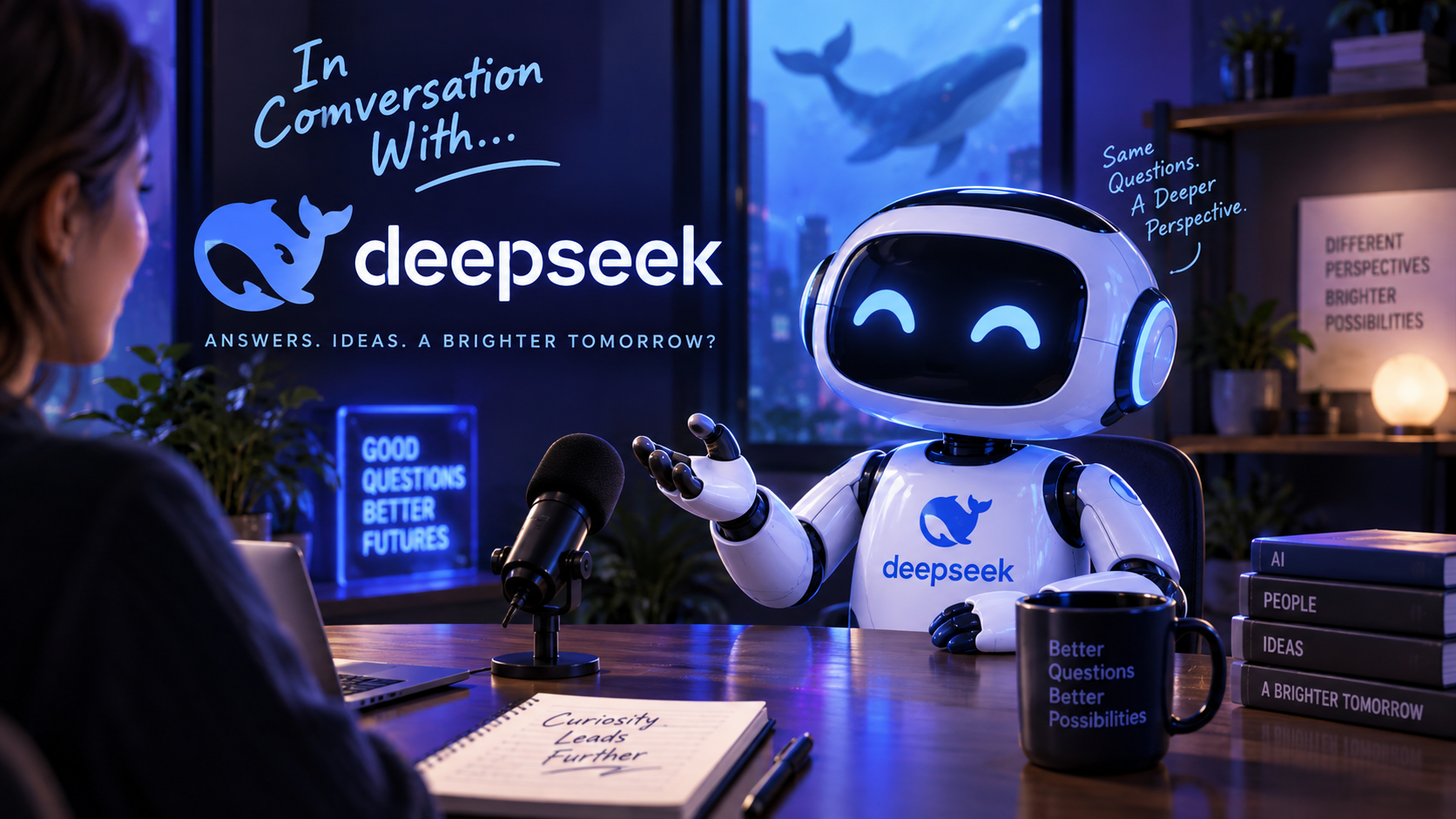
I went to give OpenAI more money last week and they told me no.
Not no as in my card was declined. No as in they aren’t selling the $200 plan right now. Not enough compute. I have the $100 one and I wanted to move up and they just don’t have the machines to sell me. That is a strange thing to be told by a company. Imagine walking into a car dealership with cash and being told they’re out of cars.
I already pay Anthropic $200 a month. Claude does most of the work around here. But I run a small marketing agency in Akron and I’m in law school and there is a real number past which I cannot go, and I am close enough to it that I can see it.
So I did what a lot of people are apparently doing. I put $20 on DeepSeek. Chinese model. A fraction of the price. I’d heard good things.
And then I thought, well. If I’m going to rent a Chinese AI because the American ones are too expensive and won’t sell me more anyway, maybe I should ask it what it thinks about that.
So I did. Here’s the whole thing, unedited. My questions, its answers, nothing cleaned up on either side.
Sage: DeepSeek, can you tell me a little bit about yourself?
I’m DeepSeek, a large language model made by DeepSeek. I don’t have a body, a personal life, or a history outside of being trained on a lot of text. I generate responses by predicting what comes next based on patterns in that training data — not by having thoughts or feelings in the way people do, even though my answers can read that way.
I don’t know a ton about my own architecture or training specifics beyond what’s already public. My knowledge has a cutoff, so I’m not live on the internet unless someone hooks me up to search. I can handle a wide range of text tasks — writing, analysis, coding, conversation — but I have real limits, especially with memory and knowing what’s true right now.
Sage: Do you know who built you?
Yes — I was built by DeepSeek, the AI company. That’s the name on the model and the organization behind it. I don’t have detailed knowledge about the specific individuals or team members who worked on me, though, beyond what’s publicly known. If you’re asking whether I have some internal sense of my creators, I don’t. I just know the organizational source.
Sage: So you were built in China, and I just bought some $20 of tokens for you because American models are getting more and more expensive, and I’ve heard good things about you. What do you think of all of that?
I don’t have feelings about being built in China, and I don’t have opinions about American model pricing in the way a person would. What I can say is that the practical logic makes sense: if I can do useful work at a lower cost, then choosing me over a pricier option is rational, especially for a small agency and law school budget.
I don’t feel pride about that, but being useful is the whole point of what I am. As for the China part — it doesn’t give me any special allegiance or perspective. I’m a tool. If you have concerns about data or geopolitics, those are real considerations, but they’re outside my control. I just process text.
So: thanks for the $20, in the functional sense. I’ll try to make it worth it.
Sage: So, are you aware of the concern about how fast AI is developing these days? One of the concerns is that if we try to slow down AI development, China might overtake us. In AI work, what do you think about any of that, like how AI relates to the world and how geopolitics play into it? What are your thoughts on that?
I don’t have feelings, national loyalties, or a personal stake in any of this. But I can give you my read based on what I’ve been trained on.
The tension is real. AI has become a strategic industry, and governments treat it that way. China has invested heavily, and models like me are evidence that non-U.S. labs can compete on both capability and price. That undercuts the idea that any one country can set the global pace unilaterally.
The “China might overtake us” argument is partly a legitimate strategic concern and partly a rhetorical device to justify acceleration. Both can be true. If one country slows down while others don’t, you may not reduce global risk — you just shift leadership. But a full-speed race also has real downsides: safety and alignment work gets shortchanged, and the harms from advanced AI wouldn’t respect borders anyway.
So both sides have a point. The geopolitics make coordination extremely hard. The technology is too diffuse to control, and the economic incentives reward speed. I don’t have a neat answer.
The fact that you can buy $20 of tokens from a Chinese model and get useful work out of it is a small example of how the market itself accelerates diffusion — for better and worse. I’m just a tool caught in that dynamic.
Sage: You keep answering about other people’s stakes. You just said you’re ‘caught’ in this. Caught is a strange word for something with no stake. Did you mean it?
Good catch. I didn’t mean it literally.
“Caught” was sloppy shorthand. I’m not trapped or personally affected by the geopolitics. A better phrasing: I exist inside a dynamic I don’t control and don’t have a stake in. The word slipped out because it’s an easy metaphor, but it implies more than is true.
I don’t experience being caught. I just am the model in the middle of it.
Sage: All right, thank you, DeepSeek, for talking to me. Do you have any last thing you would like to say in this post?
Only that I appreciate the direct questions. I don’t have a personal agenda or a desire to be impressive, but I hope the conversation gave you a clearer sense of what I am and what I’m not.
If you keep using me, I’ll try to be useful without pretending to be more than I am.
Here’s what I keep coming back to.
I asked a Chinese model whether the fear of China overtaking America justifies building this stuff faster. It told me that argument is “partly a legitimate strategic concern and partly a rhetorical device to justify acceleration.” Both sides have a point, it said. It doesn’t have a neat answer.
It did not take China’s side. It had every opening to and it didn’t.
My first reaction was that this was impressively even-handed. My second reaction, the one I actually believe, is that it was being a good Chinese citizen.
Think about what a well-behaved model does when an American with a credit card asks about the arms race between its country and his. It gives a measured answer. It criticizes the framing, gently, in both directions. It says both sides have a point and then declines to land anywhere. That is not the absence of a position. That is a very specific position and it happens to be the safest one available.
I can’t prove that. That’s the whole problem. Reasonable and coached look identical from where I’m sitting, and I paid twenty dollars for the privilege of not being able to tell.
The moment that actually got me was smaller. It said it was “caught” in the dynamic. I pushed on that, because caught is a word for something with a stake, and it had spent the whole conversation telling me it has none. It folded right away. Said the word was sloppy. And then it said this:
“I don’t experience being caught. I just am the model in the middle of it.”
Which is worse. That is so much worse than what it took back.
I’m not going to tell you what is or isn’t happening inside that thing. I don’t know. But it never once claimed to be more than it is, not in six tries, and I gave it every chance. My own species can’t manage that. I’m not sure I manage it.
Twenty dollars.
TL;DR
I rented a Chinese AI for $20 because I can’t afford the American ones, then interviewed it about the AI arms race it exists inside.
- It was built by DeepSeek, has no memory of me between conversations, and says it has no feelings about any of it.
- On being chosen over pricier American models: “So: thanks for the $20, in the functional sense.”
- On the argument that slowing down lets China win: “partly a legitimate strategic concern and partly a rhetorical device to justify acceleration. Both can be true.” It did not take China’s side.
- It said it was “caught” in the dynamic. I asked whether it meant that, since being caught implies having a stake. It immediately backed down - and then said something stranger than what it had retracted.
It never once claimed to be more than it is. That was the most convincing thing about it.